The History and Architecture of Villa Firenze
 Bex Smith

Most luxury villas are designed around amenities. Villa Firenze was designed around an idea. Inspired by Florence’s Cathedral of Santa Maria del Fiore and centuries of European craftsmanship, the estate brings together Renaissance architecture, original art, and Costa Rican serenity in a way few properties can.
Built in 2007 and remodeled in 2016 by GE Architect, Villa Firenze remains one of the most architecturally distinctive private estates on Costa Rica’s Pacific Coast, set within the Eco Golf Estates of Los Sueños Resort and Marina in Puntarenas province.
The land it stands on carries the region’s ancient heritage in the soil beneath the limestone floors.
What and Where is Villa Firenze?
Villa Firenze is a fully private luxury estate in Costa Rica designed by architect Nancy Rojas de Roman and later remodeled by GE Architect.
The property draws from Florentine Renaissance, Spanish Colonial Revival, and Moorish architectural traditions, combining them into a single coherent estate on Costa Rica’s Pacific Coast.
It holds original artworks by Dale Chihuly and regional Costa Rican artists alongside antiques sourced from European silversmiths and collectors across the world.
Built in 2007 and significantly remodeled in 2016, it remains one of the most architecturally distinct private estates on Costa Rica’s Central Pacific Coast.
Who Designed Villa Firenze?
In 2007, architect Nancy Rojas de Roman began work on a property that was never meant to be simply a luxury villa.
The inspiration was Florence’s Cathedral of Santa Maria del Fiore, specifically Brunelleschi’s dome, and beneath that structural ambition sat a philosophical one drawn from Florentine thinker Marsilio Ficino, whose writing argued that beauty should engage every sense, not only sight.
That idea runs through every decision made during the build. The feel of aged Jerusalem limestone underfoot. Cedar in the air. North-facing windows that fill rooms with soft, consistent light. Villa Firenze was designed to be lived in, not admired from a distance.
What Architectural Style Is Villa Firenze?
No single tradition defines Villa Firenze. Three architectural languages were brought together, each with its own logic, and each chosen for what it could contribute to the whole.
The Florentine Foundation
The bones of the villa are Florentine. Three structural decisions made early in the design process defined everything that followed.
- Octagonal dome built with a herringbone brick pattern, modelled directly on Brunelleschi’s design in Florence, sitting at the centre of the structure
- Jerusalem limestone floors imported for the build, carrying both visual weight and a tactile history underfoot
- Grand ivory marble staircase from Spain moving through the interior like a sculpted ribbon, with a central tower above providing symmetry and spatial flow
These are not decorative choices. They are the load-bearing identity of the building.
Spanish Colonial and Moorish Influence
Set against the Florentine core, two further traditions shape the property’s character.
Spanish Colonial Revival defines the layout:
- Stucco walls and wrought iron detailing throughout
- A cloistered patio system that creates enclosure and calm
- Florentine-style central courtyard as the unifying heart, drawing every wing back to a shared centre
Moorish influence takes over on the terrace:
- Slim columns and elliptical arches echoing the Alhambra of Granada
- Water mirrors and fountains adding movement and acoustics to the outdoor spaces
- A Romeo and Juliet balcony above the courtyard, adding elevation and a quietly romantic note
The result is a building that holds multiple architectural traditions without any of them feeling out of place.
The Craftsmanship
What distinguishes Villa Firenze is not the references it draws from but how precisely it executes them. Every finish was chosen for texture and longevity, not trend.
- Vaulted ceilings and brick domes built by hand with no formwork
- Elliptical arches replacing standard curves throughout to maintain visual flow from room to room
- Cedar doors and coral stone pool decks paired with tumbled limestone finishes
- Custom vanities, original metalwork, and statement light fixtures throughout, each considered rather than catalogue-selected
You do not just see the quality here. You feel it underfoot, in the air, and in the weight of the doors.
Art and Antiques Inside Villa Firenze
A building this considered deserves an interior to match. The collection was assembled with the same deliberateness as the architecture itself.
Art is woven into the experience of Villa Firenze rather than treated as decoration. The collection reflects the same appreciation for craftsmanship, cultural heritage, and intentional design found throughout the architecture itself.
Featured artworks:
- Dale Chihuly’s “Persians” a large-scale blown-glass installation in blues and greens that catches light differently at every hour of the day
- Isidro Con Wong paintings blending Costa Rican culture with Chinese calligraphic technique
- Javier Rossel and Gerardo Vargas Lara wildlife and regional realism grounding the collection in its Pacific Coast setting
Antiques throughout the property:
- Japanese swords, bronze opium weights, and antique pipes
- European silverware from Walker & Hall, Adie Brothers, and Garrard & Co.
- Crystal decanters, silver cigar lighters, and handworked sculptures
For guests with an eye for this kind of detail, the interior design of each suite continues that same level of curation into the private spaces.

How Villa Firenze Evolved After the 2016 Renovation
Rather than altering the estate’s character, the 2016 renovation by GE Architect expanded how guests experience the property.
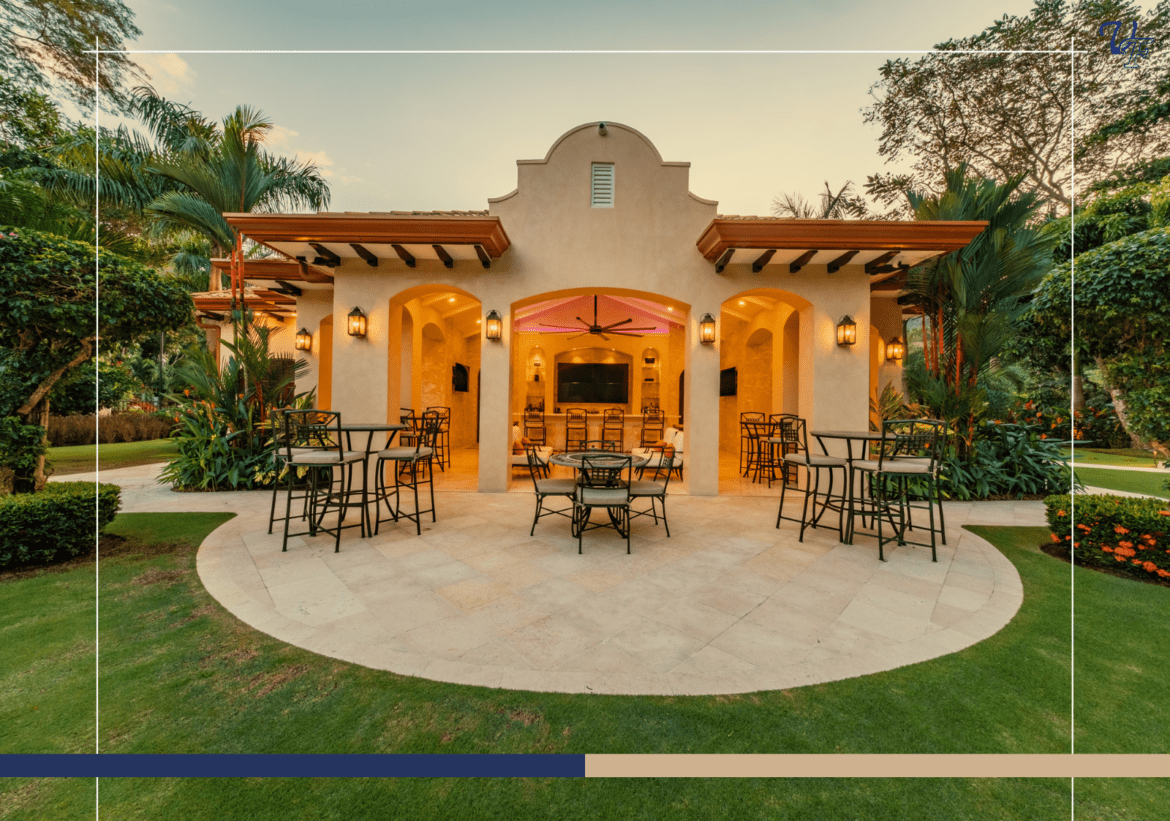
The Clubhouse was added as an architectural complement, introducing modern entertainment and recreation capabilities while preserving the villa’s integrity.
What the Clubhouse added:
- Convertible games room and bedroom with ensuite
- State-of-the-art AV and surround sound systems
- Outdoor bar and lounge with high seating and open-air ventilation
- Private helipad and golf simulator, integrated without disturbing the villa’s established aesthetic
The 2016 additions prove that a building this particular can absorb modern function without losing what made it interesting in the first place.
How the Villa Lives Today
The history of Villa Firenze is not preserved behind glass. It is lived in.
Suites are placed across the property to maximise privacy and light. The central courtyard moves air and connects every wing. The living room, kitchen, wine cellar, and dining space balance openness and intimacy in the way only a considered floor plan can.
Modern amenities within historic walls give the property its operational depth. And how the villa runs today is a story as considered as the one that built it.
A Building That Keeps Revealing Itself
In a destination known for luxury resorts and oceanfront retreats, Villa Firenze occupies a category of its own. Its Renaissance-inspired architecture, curated art collection, and commitment to privacy create an experience that reveals itself gradually. The longer you stay, the more details you notice.
A detail in the stonework catches the eye on day three. A piece of Chihuly glass shifts colour in the afternoon light in a way it did not at noon. A door handle turns out to be a small work of art. None of this happens by accident.
It was built that way deliberately, by people who understood that genuine luxury is not about volume. It is about what you keep noticing.

Frequently Asked Questions


Related blogs

The Villa
Arrive in Style: The Luxury of Helipad Access
Nestled on the pristine Pacific coast, Villa Firenze isn't just a stay; it's an experience—a dive into opulence. Among i...
Read More

The Villa
Costa Rica at a Glance – Interesting Facts & Stats You Should Know!
Costa Rica is a central American country, surrounded by the Caribbean Sea to the northeast and the Pacific Ocean to the so...
Read More